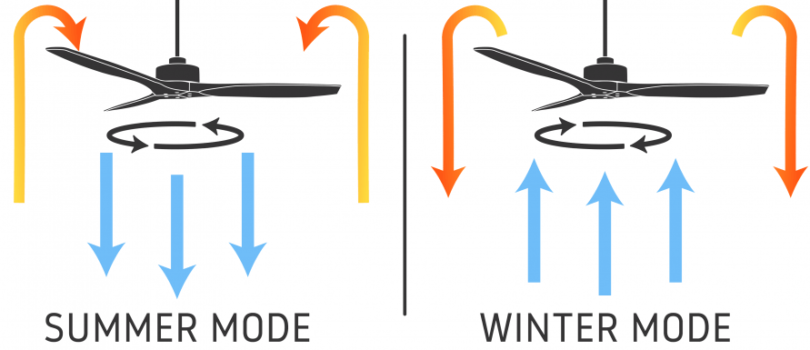
Counterclockwise on a ceiling fan means the blades rotate from right to left when viewed from directly below. This remains the standard “summer mode” for almost all residential fans. This rotation pushes air downward, creating a concentrated column of air that produces a cooling wind-chill effect on your skin.
Identifying this direction correctly is the first step toward optimizing your home’s climate control. While it sounds simple, the perspective from which you view the fan—and the speed at which it is spinning—can often lead to confusion.
Contents
Quick Visual Instructions to Identify Counterclockwise
If you need a fast answer right now, follow these three steps to confirm your fan is spinning counterclockwise. This is the quickest way to ensure you are ready for the heat.
- Stand Directly Underneath: Position yourself right under the center of the fan blades. Do not look at the fan from a doorway or an angle, as this distorts your perspective of “left” and “right.”
- Set the Fan to Low: If the fan is on high, the blades will be a blur. Turn it to the lowest setting so you can track the movement of a single blade.
- Track the Motion: Watch a single blade as it moves toward you. If it moves from your right side to your left side, it is rotating counterclockwise.
This “Right to Left” motion is the hallmark of a fan set to its summer cooling configuration.
Counterclockwise = Summer Mode
You’ll often hear experts refer to counterclockwise as “Summer Mode.” This is because of the way the fan interacts with the physics of your room.

When the blades spin counterclockwise, the angle (or pitch) of the blades “slices” into the air and forces it toward the floor. This creates a high-pressure downdraft. It’s important to note that the fan doesn’t actually lower the temperature of the room; instead, the moving air helps evaporate moisture from your skin, making you feel 6 to 8 degrees cooler.
Because you feel cooler, you can raise your thermostat by several degrees, leading to significant energy savings. For a more in-depth look at how this compares to the reverse setting, you should check our comprehensive guide on Ceiling Fan Direction for Summer and Winter.
3 Easy Ways to Confirm Counterclockwise Direction
If the visual check isn’t enough, there are several other ways to be 100% certain of your fan’s direction. Using these methods together will eliminate any guesswork.
1. The Visual Direction Test
This is the standard “Right to Left” check. Imagine the fan is a clock face on the ceiling. If the blades are moving in the opposite direction of a clock’s hands—meaning they move from 12 to 9, then to 6, then to 3—they are spinning counterclockwise. This perspective only works if you are looking up at the fan.
2. The Feel the Airflow Test
This is arguably the most foolproof method. Turn the fan to its highest speed and stand directly beneath it.
- Counterclockwise: You will feel a strong, immediate, and direct breeze pushing down on your head and shoulders.
- Clockwise: You will feel very little air movement directly below the fan, as the air is being pulled up toward the ceiling.
If you don’t feel a distinct “wind” while standing under the fan, it is likely not in counterclockwise mode.
3. The Blade Pitch Trick
If the fan is turned off, you can still tell which way it should spin to be counterclockwise. Look at the angle of the blades. For a fan to push air down in a counterclockwise motion, the “higher” edge of the blade should be leading the rotation toward the left.
Basically, the blade is angled like a shovel. As it moves right-to-left, the angled surface “scoops” the air and throws it downward.
Common Mistakes People Make
Even until now, I see homeowners get this wrong because of a few common traps. Avoiding these will help you outrank the “guesswork” that leads to higher electric bills.
- Watching from the Side: If you watch a fan from across the room, the blades on the side closest to you move one way, while the blades on the far side move the other. Always stand under the fan for an accurate reading.
- High-Speed Distortion: At high speeds, a phenomenon called the “stroboscopic effect” can occur. This makes the blades look like they are spinning backward or even standing still. Always slow the fan down to its lowest setting for a direction check.
- Assuming Airflow: Just because you see the blades moving doesn’t mean they are moving the right way. Some people assume any movement provides cooling. In reality, spinning the wrong way in summer actually traps heat in the lower half of the room.
What If You Can’t Tell the Direction?
Sometimes, despite your best efforts, it’s still hard to tell. This is common with fans that have very thin blades or unique decorative designs.
- The Paper Test: Hold a single sheet of toilet paper or a light tissue about a foot below the blades while the fan is on low. If the paper is blown downward, you are in counterclockwise mode. If it flutters upward toward the blades, you are in clockwise mode.
- Check the Remote or Switch: Most modern remotes have a “Reverse” button. If your fan has a manual switch on the motor housing, “Down” is typically counterclockwise (Summer), and “Up” is typically clockwise (Winter).
If you find that your fan is stuck or acting erratically, you might be dealing with a mechanical failure. In that case, consult our troubleshooting guides for when a Ceiling Fan Won’t Change Direction or if your Ceiling Fan Changes Direction by Itself.
Clockwise vs. Counterclockwise (Mini Comparison)
To keep it simple for the rest of the year, here is the basic breakdown of the two directions.
| Direction | Airflow Pattern | Seasonal Use |
| Counterclockwise | Downward (Downdraft) | Summer (Cooling) |
| Clockwise | Upward (Updraft) | Winter (Heat Circulation) |
If you want to understand the exact opposite of the summer setting, read our guide on Which Way is Clockwise on a Ceiling Fan.
Why Direction Matters
With energy costs fluctuating, something as simple as fan direction has a real impact on your wallet.
When your fan spins counterclockwise, it allows you to rely less on your air conditioning. This isn’t just about comfort; it’s about mechanical efficiency. A fan running in the correct summer direction uses significantly less energy than an AC unit trying to cool a room with stagnant air.
Furthermore, using the correct direction prevents “pockets” of humidity from lingering in the corners of your room. Proper downdraft circulation keeps the air fresh and prevents that “stuffy” feeling often associated with mid-summer heat.
Frequently Asked Questions
Which way should a ceiling fan spin in summer?
In the summer, your fan should spin counterclockwise. This creates a downdraft that provides a cooling breeze.
How do I know if my fan is blowing air down?
The easiest way is to stand directly under the blades. If you feel a breeze on your face and shoulders, the fan is blowing air down. If you don’t feel anything, the fan is likely pulling air up.
Can counterclockwise ever be winter mode?
No. In almost all standard fan designs, counterclockwise is strictly for cooling. Running a fan counterclockwise in the winter will create a cold draft that will make you turn up your heater, wasting money.
Why don’t I feel air from my fan?
If the fan is spinning counterclockwise and you still don’t feel air, the fan may be too small for the room, the blades may be too dirty, or it may be spinning too slowly. Alternatively, the fan may be set to “clockwise” mode.
Conclusion
Correctly identifying which way is counterclockwise on a ceiling fan is essential for staying cool and saving money. By remembering the “Right to Left” visual rule and confirming the downward airflow, you can ensure your home is optimized for the summer months.
If you find that your fan is spinning in the correct direction but still making strange noises, or if the lights are behaving oddly, you might want to look into other common issues like when a Ceiling Fan Light Turns On by Itself. A little bit of maintenance goes a long way in keeping your home comfortable.


