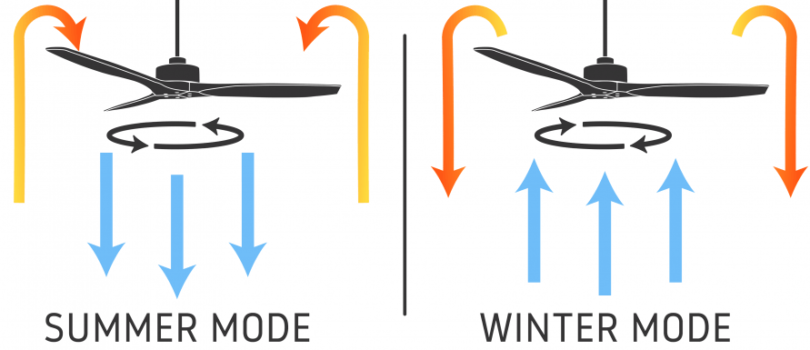
Clockwise on a ceiling fan means the blades move from right to left when viewed from below. This direction is primarily used in winter because it creates an upward airflow (updraft). This movement redistributes warm air trapped at the ceiling back down into the room without creating a direct, cooling breeze.
When you stand directly under your fan and look up at the blades, they should appear to be following the movement of a clock’s hands if they were placed on the ceiling. If the blade closest to you is moving toward your left shoulder, your fan is currently set to clockwise.
Contents
Understanding Clockwise Rotation in Simple Terms
If you find yourself confused about fan direction, you are not alone. Most homeowners only think about their fans during the heat of summer. However, knowing which way is clockwise on a ceiling fan is the key to year-round energy efficiency.
To make this foolproof, follow these three simple steps:
- Stand directly under the fan. Do not look at it from an angle or from the doorway.
- Look straight up at the blades.
- Track the movement. If the blades move toward the right side of the room at the “top” of their circle and toward the left at the “bottom,” that is clockwise.
The simplest way to remember it is “Right to Left.” This specific rotation is often referred to as “Winter Mode” or “Reverse Mode” in most home comfort guides.

The Visual Clock Analogy
Visualizing 3D movement can be tricky. To understand clockwise or counterclockwise ceiling fan orientation, imagine a large analog clock is stuck flat against your ceiling, directly behind the fan.
As the fan spins, the blades should follow the numbers on that imaginary clock: 12, 1, 2, 3, and so on.
- When a blade is at the “12 o’clock” position (furthest from you), it moves toward the right.
- When a blade is at the “6 o’clock” position (closest to you), it moves toward the left.
If you see the blades moving in this specific pattern, your fan is correctly set to rotate clockwise. This visualization helps avoid the common mistake of confusing “right” and “left” based on where you are standing in the room.
What Does Clockwise Direction Actually Do?
These days, understanding the physics of your fan is just as important as knowing the direction. When a fan spins clockwise, the angle of the blades (the “pitch”) is designed to pull air from the floor up toward the ceiling.
The Updraft Effect
This upward airflow is called an updraft. Instead of pushing a column of air down onto your skin—which causes the “wind-chill effect”—the fan draws the cool air from the lower half of the room upward.
Heat Redistribution
Because warm air is less dense than cool air, it naturally rises to the ceiling. In a room with 9-foot ceilings, the air near the top can be 10% to 15% warmer than the air near the floor. A clockwise rotation gently displaces that warm air, forcing it outward toward the walls and then back down to the floor level.
3 Ways to Confirm Clockwise Direction
If your fan is spinning at high speed, it can be hard to tell which way it’s going. Use these three methods to confirm you have the right setting.
Method 1: The Visual Check (Slow Speed)
Turn your fan to its lowest setting. Wait for it to slow down until you can clearly see the individual blades. Stand directly underneath and watch the “leading edge” of the blade. If the blade moves right-to-left across your field of vision when it is closest to you, it is clockwise.
Method 2: The Airflow Test (Feel the Breeze)
This is the most practical test. Turn the fan to medium or high speed and stand directly under it.
- If you feel a strong, direct breeze: The fan is spinning counterclockwise (Summer Mode).
- If you feel almost no air movement directly below: The fan is spinning clockwise (Winter Mode).
In clockwise mode, the air is moving up and out, not down.
Method 3: The Blade Angle Check
Look at the angle of the blades while the fan is off. The “leading edge” is the side of the blade that “cuts” into the air first. In a clockwise setting, the lowest edge of the blade should be the one leading the rotation.
Common Mistakes When Checking Direction
Even experts can get turned around when looking at fan rotation. Avoid these three common pitfalls:
- Confusing Top View vs. Bottom View: Some instruction manuals show the fan from above (as if you were in the attic looking down). However, 99% of homeowners check from the floor. Always assume “clockwise” refers to the view from below unless stated otherwise.
- Checking at High Speed: At high speeds, the blades become a blur. The human eye can sometimes play tricks, making the fan appear to spin backward (the “stroboscopic effect”). Always use the lowest speed for a visual check.
- Assuming All Fans are the Same: While most brands follow the “Clockwise = Winter” rule, some high-end industrial or DC motor fans allow for customized blade pitches. Always verify by feeling the airflow.
When to Use the Clockwise Direction
You should switch your fan to clockwise whenever you turn on your home’s heating system.
- Winter Months: This is the primary use. It helps your furnace work less by keeping the warm air where you actually live—the bottom six feet of the room.
- Rooms with High Ceilings: If you have vaulted or cathedral ceilings, the clockwise setting is essential. Without it, the heat you pay for stays trapped 15 feet in the air.
- Dining Areas: If you want air circulation in a dining room but don’t want your dinner to get cold from a direct breeze, the clockwise updraft is a great middle-ground.
Quick Comparison: Clockwise vs. Counterclockwise
Use this table as a quick cheat sheet for yourself.
| Feature | Clockwise Rotation | Counterclockwise Rotation |
| Visual Direction | Right → Left (from below) | Left → Right (from below) |
| Airflow Pattern | Upward (Updraft) | Downward (Downdraft) |
| Season | Winter / Cold Weather | Summer / Hot Weather |
| Primary Goal | Redistribute trapped heat | Create a cooling wind-chill |
| Feel | No direct breeze | Strong, direct breeze |
Further Reading
For a complete guide on when to use each direction, read our detailed article on Ceiling Fan Direction for Summer and Winter. Understanding the seasonal shift is the best way to lower your utility bills.
You can also check our specific guide on Counterclockwise Ceiling Fan Direction for cooling, where we explain how to maximize the wind-chill effect during the hottest parts of the year.
Final Summary: The Clockwise Checklist
To wrap up, here is everything you need to remember about which way is clockwise on a ceiling fan:
- Rotation: Blades move right to left when you look up at them.
- Season: It is strictly for winter or cold-weather use.
- The Effect: It pulls cool air up and pushes warm air down the walls.
- The Benefit: It can save you up to 10% to 15% on heating costs.
If you stand under your fan right now and feel a cold wind blowing on your head, you are not in clockwise mode. Flip that small switch on the motor housing or hit the “Reverse” button on your remote to start saving energy today.


